SMITHBITS RADIO MAGAZINE

Friday, December 19, 2014

Haiti's face their issues of Another Black Boy Gunned Down By Police

Another Black Boy Gunned Down By Police

Posted: Updated: 
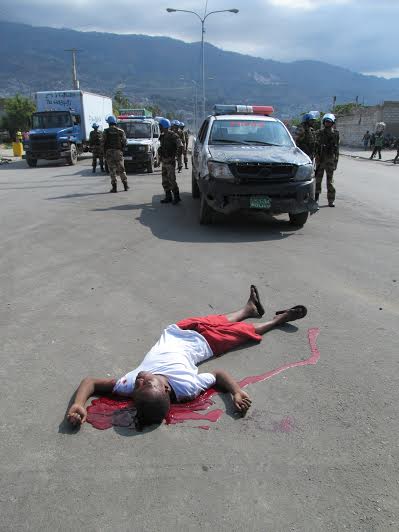
2014-12-18-blackboyshot.jpg
Photo Credit: Beverly Bell. 
We will never learn of the names, lives and deaths of countless Black men and boys murdered by police -- and slavery enforcers, hate groups, vigilantes, and a host of others -- dating back to the earliest days of this country's history. The names and stories of a slew of recent victims of extrajudicial executions, such as Eric Garner and Michael Brown, and the exoneration of their killers, have become widely known through the blowback of public fury.
This is a tale of another Black boy whose name and wrongful death were never reported in any official document or national media. The policeman responsible was not charged, indicted, or prosecuted. This child's prematurely snuffed life was not spent in the U.S. but in the Black nation of Haiti, though the U.S. government subsidized his murderer.
In Port-au-Prince on a sweltering day last spring, the collective taxicab I was traveling in turned onto Bicentennaire Street, barely avoiding the prone body of a young teen. Arms thrown out like a startled baby's, he lay in a pool of blood. I spun around in the seat to look. A Haitian passenger, more accustomed to gritty daily reality, looked at me strangely. "What's wrong with you?" she asked.
One truck of Haitian police and two more of UN occupation troops next to the body raised my suspicion, as both parties have been responsible for incalculable harm.
I extricated myself from the crowded cab and ran to the scene. The boy had been shot in his skull and eye. The part of his T-shirt that was not yet covered with blood, which was still flowing from the holes, gleamed white. His mother or sister had surely recently hand-scrubbed that shirt with care.
A policeman told me he had been shot by a "bandit." A bandit robbing and shooting this boy was implausible: emaciated children from that destitute neighborhood do not circulate with riches. That he himself might have been involved in banditry was equally incredible: plastic flip-flops do not make good getaway shoes.
I began asking onlookers and street merchants if they knew what had happened. But two policemen followed me, and so no one had observed anything. As I continued my investigation up a dirt alleyway, one of the cops asked, "Where are you going?" "Just walking," I said. "Don't you need company?" he replied. They laughed.
At a bend in the alley, I ducked behind a tin fence before the police caught up with me and asked a man welding what he had seen. He said the police had driven up and thenthe shots had rung out.
Police brutality is a time-honored tradition in Haiti. Today, under fraudulently elected President Michel Martelly, the force's killings and abuses -- especially of demonstrators, activists, and journalists - are growing. Just this past Sunday, December 14, police attacked anti-government demonstrators in the capital city, killing one.
The U.S. has had a hand in taking down these Black lives. In the three years since Martelly was imposed, the U.S. has underwritten his unaccountable "security" forces to the tune of $73 million, courtesy of our tax dollars. The US has also sold the Haitian government weapons that make the assaults possible. (This same support has gone to many a Haitian autocrat, notably François and Jean-Claude Duvalier.)
Likewise, UN troops - globo-cops - have assassinated, raped, arbitrarily arrested, and committed other human rights violations during their ten-year occupation of Haiti. Moreover, the force is responsible for the deaths of more than 9,000 through cholera, after troops infected with the disease dumped their raw sewage in a river. When families of the victims filed a lawsuit for compensation, the UN claimed legal immunity. (The cholera lawsuit continues nevertheless.)
Haitian and UN forces are Daniel Panteleo, the NYPD officer who strangled Eric Garner to death as he placidly vended cigarettes on a sidewalk. They are Darren Wilson, the St. Louis cop who shot the unarmed teenager Michael Brown seven or eight times. These badge-wearers, and so many more like them, stand above the law.
The continual malfeasance, and exemption from accountability and punishment, of the Haitian police and the UN occupation force would be unthinkable, unacceptable, in a high-income white nation. However, those who control power and those with white skin typically respond to state-sanctioned lawlessness in low-income Black neighborhoods and countries by choosing to remain uninformed; ignoring the matter; or rewriting the narrative as gang activity, Black-on-Black violence, or common crime.
In the global division of capital and human value, a dead Black Haitian like the one lying on Bicentennaire Street was IS? one more worthless body in a worthless life in a worthless piece of real estate.
Both the street-beat cops and the blue helmets are themselves predominantly low-income and Black or brown. They are pawns in a globalized system of political and physical violence, underpaid proxies helping to maintain dominance of the world's elite nations and classes. On the streets, they mirror on a micro-scale the unjust global relations, endowed as they are with personal power that allows them to be protected perpetrators of crimes on those more vulnerable than they.
Two ambulances joined the police and UN trucks. The officials sauntered between the vehicles, talking to each other. No one paid any attention to the blood-drenched body. The men wrote nothing, photographed nothing. Finally, gloved corpse-slingers approached and searched the pockets of the child's nylon shorts; they found them entirely empty. They tossed the cadaver into a litter and into the back of the ambulance. I suspected they would dump him in a potter's field, perhaps after a quick stop at the morgue, and that that would be the end of the story. I would have wagered a large bet that there would be no time spent preparing documentation for headquarters or for possible later identification by his desperate mother. I would have bet everything I owned that a forthcoming lunch mattered a lot more to those men than due process. Likely, this had been just another stop in a routine day. 
Still, more public resources were being spent on the boy at that moment than throughout his entire life. Now, however, they were too late to be of any use to him.
Walking back home, I got caught in a wave of little children leaving kindergarten with their parents. They were a sea of blue shorts, blue pinafores, and blue hair ribbons. Which of them would be blown away by their government?
And which would grow up to be protesters in marches, and advocates in campaigns, like those going on all over the US now? Which would commit him or herself to a country in which everyone's husband, father, son, and brother - and wife, mother, daughter, and sister - have worth? And what country would they create?
As I penned this article under the drone of police helicopters that circulate every night from sunset until well past midnight above the interlocked towns of Oakland and Berkeley - both of them in full rebellion -- an email came in from a workers' rights group in Haiti. It read, "We are made nauseous by seeing assassination after assassination by the US police, with impunity, on any citizen - as long as they happen to be Black... and also by the complete protection of the corrupt justice system... We salute the mobilization of people in that country."
May the resistance and protest grow in strength. May they flourish into strategic organizing and sustained movement-building for physical security, economic and social equality, democratic rights, and government accountability vis-à-vis Blacks and other people of color. May this be so in the US and Haiti and everywhere that is sickened by the poison of structural racism.
Black lives matter.

A revised version of this article appeared as "Another Poor Black Boy Dead in Haiti", Truth Out, April 7, 2013.
Beverly Bell has worked for more than three decades as an advocate, organizer, and writer in collaboration with social movements in Latin America, the Caribbean, Africa, and the U.S. Her focus areas are just economies, democratic participation, and gender justice. Beverly currently serves as associate fellow at the Institute for Policy Studies and coordinator of Other Worlds. She is author of Walking on Fire: Haitian Women Stories of Survival and Resistance,  Fault Lines: Views Across Haiti's Divide, and Harvesting Justice: Transforming Food, Land, and Agricultural Systems in the Americas.
Copyleft Beverly Bell. You may reprint this article in whole or in part.  Please credit any text or original research you use to Beverly Bell, Other Worlds.

Saturday, December 13, 2014

Country singer Dawn Sears dies


Dawn Sears, center © AP Dawn Sears, center The Time Jumpers star Dawn Sears has lost her battle with lung cancer at the age of 53.The country singer, a Minnesota native, passed away in Tennessee on Thursday night (11Dec14).

An in-demand vocalist and back-up singer, Sears worked with the likes of Ronnie Milsap, Merle Haggard and Tracy Byrd, while she also served as a longtime member of Vince Gill's touring band.

She enjoyed a solo career in the 1990s, with hits like Runaway Train, and, in 1998, formed The Time Jumpers group, which included her husband, fiddler Kenny Sears.

The Time Jumpers earned two Grammy Award nominations for their self-titled 2012 album.

Sears was diagnosed with cancer in early 2013 and subsequently used her fame to raise money for lung cancer research at Nashville's Vanderbilt-Ingram Cancer Center.

In October (14), she recruited her pal Reba McEntire to headline a benefit gig in the country music Mecca and put on a brave face as she performed with her band.

She told the audience, "It is my mission to bring more hope to those of us with lung cancer. I was diagnosed with lung cancer over a year ago and I now have a greater understanding of the daily battle and challenges that people with cancer of any kind face."

The concert raised more than $100,000 (£62,500) for the cause.

Thursday, December 11, 2014

Woman on Arizona's death row for 22 years has had murder charges against her dismissed


Arizona court tosses charges against woman on death row for 22 years
By Michael Muskal 


Woman on Arizona's death row for 22 years has had murder charges against her dismissed
December 11, 2014, 6:20 PM


An Arizona appeals court has dismissed murder charges against Debra Jean Milke, who spent 22 years on death row in connection with the 1989 death of her son..

In a decision released Thursday, the court ruled that Milke could not be tried again because such a proceeding would constitute double jeopardy. Milke was convicted of first-degree murder but the conviction was overturned more than a year ago by a federal court.Milke was released from prison on Sept. 5, 2013, according to Doug Nick, a spokesman for the state Department of Corrections.
The Arizona Court of Appeals has ruled that charges can't be refiled against Debra Milke in the 1989 death of her son. (Arizona Department of Corrections)

The case became a cause celebre in Arizona because in 1990 she was the first woman to be sentenced to death there since 1932. Milke, whose mother was German, also drew support from Germany and Switzerland, which have no death penalty.

A spokesman for the Maricopa County prosecutor said the decision would be appealed to the state’s Supreme Court. A defense lawyer declined to discuss the case.

The case began in 1989 with the death of Milke’s 4-year-old son, Christopher, whose body was found in the desert outside Phoenix.

The prosecution argued that Milke had two men kill her son. The men, Roger Scott and Jim Styers, were convicted and are on death row.

At her trial in 1990, Milke was convicted of state charges including first-degree murder. The case relied on the testimony of Phoenix police Det. Armando Saldate, who said that Milke had confessed.
There was no recording of the confession, but jurors believed the detective, who has since retired.
Milke insisted she was innocent and denied any confession. She eventually appealed to the U.S. 9th Circuit Court of Appeals. The federal appeals court cited numerous instances in which Saldate committed misconduct in previous cases and ruled that the state should have told the defense about those incidents.

Prosecutors had been planning to retry Milke for murder next year, but Saldate balked at testifying for fear of federal misconduct charges.

Meanwhile, Milke sought dismissal of the entire case, arguing that there was no other evidence aside from her purported, and contested, confession.

In its ruling, the Arizona court granted Milke’s request “because of the state’s severe, egregious prosecutorial misconduct in failing to disclose impeachment evidence.”  Follow @latimesmuskal for national news.

Saturday, December 6, 2014

Mike Nifong is the reason that District Attorney's across America toss their cases to the Grand Jury

Protesting to Prosecution -The Duke Lacrosse Player Still Outrunning His Past - Where in the World is Michael Nifong?

By  


The primary demand of protestors in Ferguson, MO, is the prosecution of the police officer who shot and killed an unarmed African-American teen, Michael Brown. Not only protestors on the street, but elected African-American officials and activists like Jesse Jackson are also demanding the immediate arrest, and quick trial, of the officer. These public officials and figures often predict that the policeman will be convicted of one or another variety of homicide.

The history of the prosecution of alleged perpetrators of violence against African-American victims brought about with heavy public and political pressure hasn't been good for the alleged victims and those who conducted the prosecution.

Perhaps the worst outcome for a prosecutor was that experienced by district attorney Mike Nifong following his unsuccessful pursuit of rape charges made by an African-American woman against three Duke lacrosse players in 2006. The case was removed from his direction, the charges were dropped, and Nifong was disbarred for "dishonesty, fraud, deceit and misrepresentation," the only North Carolina prosecutor ever disbarred in pursuing the work of his office.

The other recent case that achieved the visibility of the Duke lacrosse case was the shooting death in Sanford, FL of Trayvon Martin, another unarmed African-American teen, by George Zimmerman, a neighborhood watch guard. Initially released by the local police chief, six weeks after the shooting, following widespread protests and intense media coverage, Zimmerman was charged with murder by a special prosecutor appointed by Governor Rick Scott. Zimmerman was acquitted of second degree murder charges after a sensational and widely covered trial.

The fallout was not good for the prosecution. In particular, State Attorney Angela Corey was accused of extreme ineptness, and Alan Dershowitz charged that her actions "bordered on criminal conduct." In the aftermath of Zimmerman's acquittal, there was widespread discussion that the U.S. Attorney General, Eric Holder, might bring federal charges against Zimmerman for a hate crime and violation of Martin's civil rights. But such a case would have involved an even higher level of proof than the disallowed murder charges, and was never seriously considered.

In retrospect, we can see that political pressure led to these unwise, or unwinnable, criminal prosecutions. Community outrage and political pressure are not good indicators of the viability of a criminal case. I won't, and can't, evaluate the strength of the case against the police officer who shot Brown. However, it is easy to see the same dynamic in operation as occurred in the Duke and Trayvon Martin cases. This has led the president to take a highly cautious approach to the case, which may be expected to also characterize the involvement of federal authorities, including Holder, in considering any criminal prosecution. And, in Ferguson, we must remember that the shooter was an on-duty law enforcement officer -- unlike Zimmerman.

But that won't stop people from demanding a prosecution, perhaps with increasing fury.
Stanton Peele has been empowering people around addiction since writing, with Archie Brodsky, Love and Addiction in 1975. He has developed the on-line Life Process Program. His new book (written with Ilse Thompson) is Recover! Stop Thinking Like an Addict with The PERFECT Program. His website is peele.net.

The Duke Lacrosse Player Still Outrunning His Past

When three Duke University lacrosse players were falsely accused of rape, in 2006, the media descended on Durham, North Carolina, quickly turning the case into a story of race and privilege. Most of the country all but assumed their guilt, thanks, in part, to an e-mail—violent, profane, and referencing Bret Easton Ellis’s American Psycho—sent by sophomore defenseman Ryan McFadyen. Never charged, McFadyen speaks to contributing editor and fellow Duke alumnus William D. Cohan, in an excerpt from Cohan’s new book, about putting the past behind him.
 
By Gerry Broome/AP Photo.
McFadyen at practice in September 2006, the team’s first since their previous season was canceled five months earlier.

As McFadyen remembers it, when the dancers arrived, Flannery announced, “‘Hey, both girls are here, and they’re chocolate.’” “‘Hell yeah, bring them in,’” replied Devon Sherwood, the team’s only black player. (Sherwood says he made no such comment.)

Around midnight, McFadyen and some of his younger teammates went back to their dorm rooms at Edens, on Duke’s West Campus. “Hung out for a bit. I wrote my e-mail. I go to sleep, ” McFadyen remembers. The e-mail he is referring to, he says, was a riff on the Bret Easton Ellis novel American Psycho, which was required reading in some Duke literature courses. The book and the 2000 movie based on it were favorites of McFadyen’s. “To whom it may concern,” his e-mail began, “tomorrow night, after tonights show, ive decided to have some strippers over to edens 2c. all are welcome.. however there will be no nudity. I plan on killing the bitches as soon as the[y] walk in and proceding to cut their skin off while cumming in my duke issue spandex . . all in besides arch and tack [two of his teammates] please respond”

Then he went to bed.

The entire Duke-lacrosse criminal case, from the night in question to the dismissal of the criminal charges against three players—Collin Finnerty, Reade Seligmann, and David Evans—took 13 months.

In that time, lacrosse coach Mike Pressler was forced to resign; the remainder of the team’s promising 2006 season, for which Duke returned six All Americans, was canceled; and nearly the entire nation, including many of the players’ own professors, presumed their guilt.

Pressler would eventually settle with the university for an unknown amount, and Finnerty, Seligmann, and Evans are thought to have received as much as $20 million each in a confidential settlement with Duke. If that is correct, then between legal fees, settlements, and other public-relations fees, the party on the night of March 13, 2006 may have cost Duke $100 million.

For what was subsequently adjudged to be his many shortcomings in the handling of the Duke lacrosse case, Durham County District Attorney Mike Nifong was fired from office, was disbarred and was sentenced to one day in jail—the only person who spent any time in jail in connection with the case. Faced with the prospect of $180 million worth of lawsuits filed against him by the Duke players, he also filed for personal bankruptcy.
The cover of William D. Cohan’s The Price of Silence: The Duke Lacrosse Scandal, the Power of the Elite, and the Corruption of Our Great Universities, due out April 8 from Scribner.

For Ryan McFadyen, however, there was no multi-million-dollar settlement and no public apology. (A lawsuit he filed, along with two of his teammates, against Duke and others is still pending.) For him what has lasted is that e-mail—sent on a whim, at two in the morning—which encouraged much of the country to believe that the narrative put forth by Crystal Mangum, the “victim/accuser,” as she became known, might actually be true. It is a cautionary tale about one of the still-evolving dangers of our new, all-encompassing digital era: how the dispatching of a single, flippant e-mail to a select group of friends after a night of partying can change your life forever.

Initially, the only reaction to the e-mail McFadyen received came from his teammate Erik Henkelman at practice the next morning. “I distinctly remember Erik Henkelman getting my joke,” McFadyen recalls. “I walked in, and he was like, ‘Dude, that e-mail was so funny.’” Afterward, “We’re walking towards East Campus, and there’s a cop car parked in front of 610,” McFadyen says, and the police were talking to some of his teammates. “Apparently, that stripper [Mangum] called the cops or something.” It would be another day or two before Coach Pressler told players that Mangum was claiming she had been raped.

At first, according to McFadyen, the players did not think it was a big deal to give DNA samples to the Durham police. “We were so convinced that nothing happened,” he recalls. “The cops were like, ‘You give it and nothing matches, it’ll be over.’ O.K., well, nothing is going to match. Take our DNA. Just take what you need.” He said the police took a mouth swab, some of his hair and fingernails.

Since Mangum had told investigators that she had viciously scratched her attacker, the police were also looking for evidence of scratches on the players’ bodies. At the Durham police station, the 46 white lacrosse players on the Duke team stripped down to their boxers. “We all got basically naked and they took pictures of our bodies,” McFadyen says. “I mean, we’re lacrosse players. We’re young, 20-year-old guys. We’re covered in bruises. We’re scratched up. I remember Reade [Seligmann, a sophomore midfielder] had a—because we beat the shit out of him in practice—had a bruise down his arm. ‘Oh my god,’ they said, ‘take a picture of this,’ and they’re documenting his arm.”

On March 27—two weeks after the party—Durham police officers Mark Gottlieb and Benjamin Himan were in a training class when Police Corporal David Addison summoned Gottlieb to step outside to see a “disturbing message”: Ryan McFadyen’s e-mail. The officers agreed it “was written in a manner that indicated the possibility of two or more people may have conspired to kill someone,” according to Gottlieb, the lead police investigator on the lacrosse case. The e-mail—which found its way to investigators through CrimeStoppers, a community-oriented program coordinated by Addison—had been sent by one Ryan McFadyen, just before two A.M. in the early morning hours of March 14, some 90 minutes after the party at 610 North Buchanan had ended.

 
Crystal Mangum, Duke lacrosse accuser, convicted of murder

Crystal Mangum: In 2006, the Duke lacrosse accuser lied that she was raped by three lacrosse players. Now Crystal Mangum has been convicted of murdering her boyfriend. Mangum claimed self defense.

By , Associated Press

  • close
    A tear runs down Crystal Mangum's face as her verdict of being guilty of second-degree murder is read Friday Nov. 22, 2013 in the stabbing death of her boyfriend, Reginald Daye, in 2011. Mangum was sentenced to a minimum of 14 years and two months to a maximum of 18 years in prison.
    View Caption
The woman who falsely accused three Duke University lacrosse players of rape was convicted of second-degree murder Friday in the stabbing death of her boyfriend.
The jury deliberated for about six hours over two days before reaching its verdict in the trial of 34-year-old Crystal Mangum, who was sentenced to between 14 years and 18 years in prison.
Killed was 46-year-old Reginald Daye, who was stabbed on April 3, 2011. He died of complications 10 days later.

Mangum claimed the stabbing was a case of self-defense, saying Daye was beating her in a jealous rage when she grabbed a knife and "poked him in the side."

Assistant District Attorney Charlene Franks told the jurors during closing arguments that the evidence did not back up Mangum's story.

In 2006, Mangum falsely claimed Duke lacrosse players gang-raped her at a team party where she was hired as a stripper. The case caught the nation's attention, as the coach was forced to resign and the university canceled the remainder of the season.

The three players arrested were eventually declared innocent by North Carolina's attorney general after Mangum's story crumbled and her mental stability was questioned. The Durham prosecutor, Mike Nifong, who championed Mangum's case, was later disbarred.

The 2006 case raised larger issues, such as questions about prosecutorial power, according to The Christian Science Monitor.
"If you look at how American politics has developed in the last 20 years, there's a consistent pattern of getting tough on crime, reducing civil liberties, and giving more power to prosecutors," says Robert "KC" Johnson, a Brooklyn College professor who covered the Duke case through a daily blog. "This is really the first high profile event ... where there's been a very strong push by most people, regardless of ideology, in the other direction."
Other legal experts say the Duke case is an isolated incident in which an overzealous and relatively inexperienced prosecutor was thrust into a high-profile case involving a black exotic dancer who accused three white university students of rape at a boozy off-campus party.
"It became a pressure cooker where the top blew off," says Peg Dorer, director of the North Carolina District Attorneys' Conference in Raleigh.
Copyright 2013 The Associated Press. All rights reserved. This material may not be published, broadcast, rewritten or redistributed.


Thursday, December 4, 2014

Pantaleo - I feel very Bad About Killing Mr. Eric Garner


MEMPHIS TN (IFS) -- Several weeks ago, I opened my SmithBits Blogtalk Radio Show up with Ice-T's "Cop Killer".  It was a little to much for the listening audience to digest.  The parody of the story, is when cops do things that kill their own careers.  I was always taught, that if it walks like a duck, talks like a duck, or swims like a duck -- IT"S  A DUCK!!

So how many ways does putting a chokehold on a citizen and killing him, not murder?  When a Grand jury, says that it's not so, until it happens to you or your loved ones.

So the double standard continues in AMERICA even with video that shows a rabit punk ass cop killing a citizen IN COLD BLOOD MURDER and it's LEGAL!!

It's will not be to hard for Officer Pantaleo to get a partner each and every morning of work, with a target on his back.  I for one do not want to be anyway close to him, for a disgruntle citizen may mistake his partner for him instead.  

Oh yea, his commanding officer was an unidentified black female sergeant who headed the operation that killed Mr. Garner.  And yet, she is as guilty as the rest of those officers who have no ears and could not hear a person crying for help as they were killing him on camera and before the eyes of the world.

Police Officer Says He Feels 'Very Bad' About Eric Garner Choke Hold Death

PHOTO: Daniel Pantaleo, the Staten Island cop accused of putting Eric Garner in a fatal choke hold, was not indicted by a Staten Island grand jury.


A New York City police officer who will not be indicted for the death of a man he put in a choke hold has spoken out for the first time since the incident.

Police Officer Daniel Pantaleo, 29, was suspended in mid-July following the death of Eric Garner. He issued a statement today after it was announced that a Staten Island grand jury has declined to indict the officer.

"I became a police officer to help people and to protect those who can't protect themselves," Pantaleo said in the statement. "It is never my intention to harm anyone and I feel very bad about the death of Mr. Garner. My family and I include him and his family in our prayers and I hope that they will accept my personal condolences for their loss."


Garner's family has already announced that they intend to file a wrongful death lawsuit against NYPD for $75 million.

Jonathan Moore, the attorney for Garner's family, said that the grand jury's decision not to indict the police officer shows marked similarities to the decision of the Ferguson, Missouri, grand jury when it chose not to indict police officer Darren Wilson, who fatally shot unarmed teen Michael Brown.
"The family is very upset and disappointed that these officers are not getting indicted for any criminal conduct," Moore said.

The family also took issue with the way that the police officers involved were handled when it came to their grand jury testimony. Both Pantaleo and his partner testified in front of the 23-person jury. The partner had immunity from prosecution at the time of his appearance.

"As we saw in Ferguson sometimes these grand jury’s turn into trials without the real parties being present to cross examine the participants," Moore said in the statement. "It’s hard to believe that that all the officers other than Daniel were granted immunity. As evidenced by the video there were several officers who impacted Mr. Garner while he was on the ground. These officers were granted immunity before any evidence was ever presented."

The president of the city's Patrolmen's Benevolent Association, Patrick Lynch, said that while they are "pleased" with the decision, "there are no winners today."

"It is clear that the officer's intention was to do nothing more than take Mr. Garner into custody as instructed and that he used the take down technique that he learned in the academy when Mr. Garner refused," Lynch said in a statement.

The July 17 incident was caught on video and NYPD Commissioner Bill Bratton previously described the officer's move as a choke hold, which is not an approved technique for the police department.

Bratton also said that every member of the NYPD would have to be retrained in light of the incident.

Wednesday, December 3, 2014

Crye-Leike Property Management - Real Estate Predators and Con Artists

MEMPHIS TN (IFS) -- If you are a small business property owner, this writer strongly suggests that you stay far away from these cut-throats and thieves.  The terrible stories connected with the old company is enough to drive you to drinking and doing something very awful to these people.

First of all, go to any other property management company for management.  They love to create false documents and work orders for "phantom jobs" to your property, and it's always hundreds to thousands of dollars over and above the job, if there is one.  If you get something done by them, it's always an emergency and they keep your money.

During inspections for final, they always side with the tenant and their "mock inspections" never points to the obvious issues caused by the tenant, but always to the property owners as being at fault..

My daughter sent me this email as an attachment to Mr. Phil Gentry, Crye-Leike chief inspector, and it is full of holes, and he never gives you the right story about your property.

The only thing this company is good for is stealing.  Take your business elsewhere and leave these people alone.